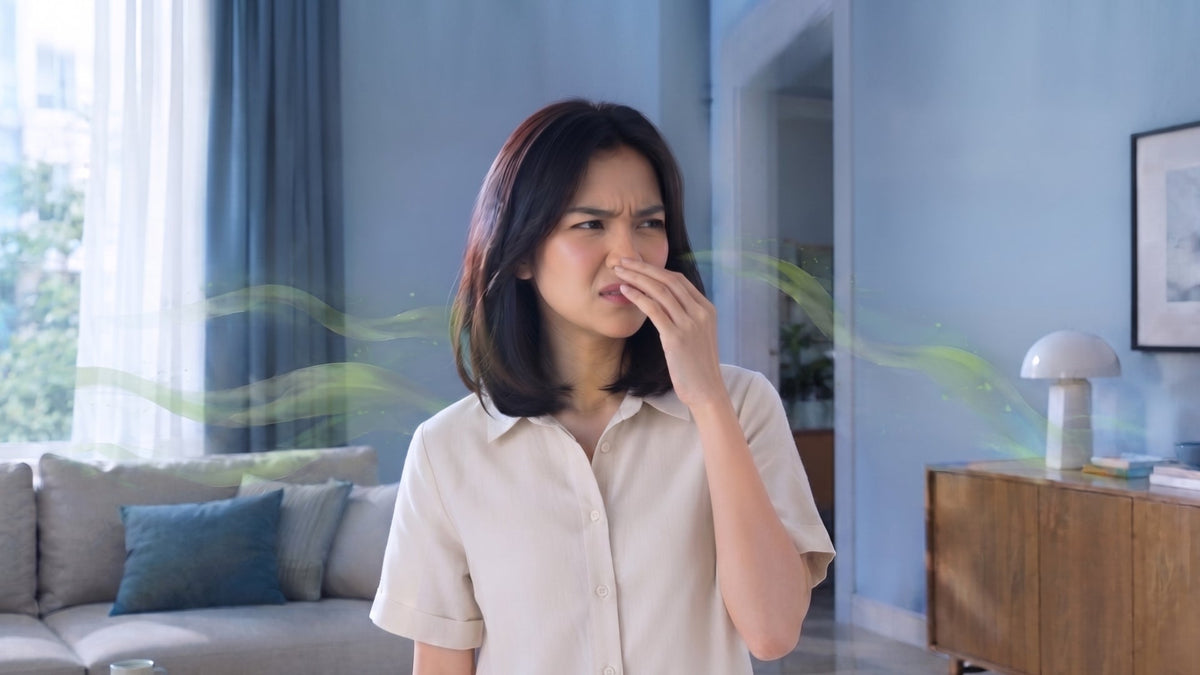
- 🧬 A child’s development begins long before birth. The air parents breathe before conception can influence fertility, pregnancy, and lifelong health outcomes.
- 🤰 Air pollution can reach the developing baby during pregnancy, affecting the brain, lungs, immune system, and overall growth.
- 🧠 Pollution is not just a lung issue. Early-life exposure has been linked to impacts on cognitive development, hormones, immunity, and long-term health.
- 🏡 Every reduction in exposure matters. Cleaner indoor air during the first 1,000 days can provide benefits that last for decades.
A child's life is shaped long before their first cry. New science is making clear that the air around their parents — months before conception, all through pregnancy, and across every quiet hour of early childhood — quietly helps decide who they become.
The Story Begins Before The Story Begins.
Every parent learns the language of nutrition early. Folic acid. DHA. Calcium. Iron. The vitamins that build a baby's body. But there is one ingredient a child draws on every second of every day — long before their first meal, long before their first breath — and most of us have never been taught to think about it carefully. Air.
For decades, air pollution lived in the background of public health conversations. The haze that returns each dry season. A nuisance, not a foundation. That has changed. In May 2025, Harvard's Center on the Developing Child published a major synthesis of the evidence and reached a striking conclusion: clean air is not a side issue in early development. It is one of the central environmental forces shaping a child's brain, lungs, immune system, hormones, and lifelong health
The research is not meant to frighten. It is meant to inform — because once we understand how deeply the air around us shapes the children we love, we also begin to see how much power we have to make it better.
It surprises most couples to hear that the environment around them in the months before conception may already matter to the child they hope to have. But the biology is straightforward. A man's sperm cells take roughly
72 to 90 days to mature. A woman's eggs spend even longer in the final maturation phase before ovulation. Whatever those cells are exposed to during that window — including what their parents breathe — can leave a mark.
A 2026 meta-analysis pooling evidence from major review studies confirmed what reproductive specialists have suspected for years: higher air pollution exposure is consistently associated with lower sperm motility, reduced concentration, and abnormalities in shape. The pollutants most often implicated — fine particulate matter (PM2.5), nitrogen dioxide from traffic, sulfur dioxide — are precisely the ones that hover over Indonesian cities every day.

For women, the picture is similarly serious. Studies have associated higher pollution exposure with diminished ovarian reserve, irregular menstrual cycles, and reduced success rates in IVF treatments. A 2025 Emory University study examined over 1,400 IVF cases and found that organic carbon from sources like vehicle exhaust was associated with poorer oocyte survival and fertilization outcomes — for both prospective mothers and fathers.
None of this means a couple in a polluted city cannot have a healthy baby. They can, and most do. What it means is simpler: the months before trying to conceive are not "before" the story. They are the opening chapter.
What The Mother Breathes, The Baby Becomes
For a long time, the placenta was thought of as a near-perfect filter — a biological sanctuary that kept the worst of the outside world away from the developing fetus. We now know that picture was too generous.
In 2019, a Belgian research team published a study in Nature Communications
using a novel imaging technique. They examined placentas donated by mothers in northern Belgium — a region with relatively modest pollution levels by global standards — and found, in every single placenta they screened, microscopic
black carbon particles. These are the same combustion-derived particles emitted by car engines, generators, and industrial chimneys. The particles were embedded in the placental tissue on the side facing the fetus
The amount of particles correlated directly with how much pollution the mother had been exposed to during pregnancy. The implication was clear and quietly devastating: when a pregnant woman breathes polluted air, those particles can make their way through her bloodstream to the very edge of her baby's developing world.

Subsequent research has only strengthened the case. A 2025 review in Frontiers in Cellular Neuroscience reported that high-resolution fetal MRI now links mid-pregnancy exposure to nitrogen dioxide, PM2.5, and black carbon with measurable reductions in fetal brain volume. Other 2024–2025 work has shown that prenatal pollution exposure is associated with epigenetic changes in placental genes involved in neurodevelopment — biological "settings" that can affect how a child's brain grows long after birth.
The Harvard 2025 paper summarizes the consequences with care: prenatal exposure to airborne particles and gases is associated with increased risk of premature birth and low birth weight — both of which are themselves risk factors for a wide range of developmental problems later in life.
It Was Never Just The Lungs
The biggest shift in modern science is this: pollution is no longer understood as a respiratory issue with side effects. It is understood as a whole-body event. When ultrafine particles are inhaled, many of them do not stop in the lungs — they pass into the bloodstream, and from there reach almost every organ.

The Home — and The Air Inside it
Most parents picture pollution as something that happens outside: traffic, smoke, dry-season haze. The harder truth is that we spend more than 90 percent of our lives indoors — and during pregnancy and early childhood, often more. The U.S. Environmental Protection Agency estimates that levels of indoor air pollutants can be two to five times higher than outdoor levels, due to a combination of poor ventilation, chemicals released from furniture and cleaning products, byproducts of gas stove use, tobacco smoke, and outdoor pollution leaking in through windows
For families in Greater Jakarta, where average ambient PM2.5 has been measured at
42.5 µg/m³ well above both Indonesian national standards and World Health Organization guidelines — this combination of indoor and outdoor exposure becomes especially significant. A 2025 citizen-science study by Vital Strategies found that
about four in five Jakarta school-age children were exposed to PM2.5 levels exceeding the national standard across a 24-hour monitoring period

The hidden chemistry of a modern home is itself worth pausing on. Volatile organic compounds (VOCs) released from new furniture, fresh paint, and many cleaning products. Particles from cooking, especially with gas. Dust carrying flame retardants and "forever chemicals." Mold spores in humid corners. Fragrances designed to linger. Tobacco residue clinging to surfaces. Most are invisible. None are felt directly. All quietly add to the daily burden a child's body has to manage.
Why Any Reduction Matters
The most encouraging part of this science is that the body is remarkably responsive. Cleaner air, even introduced part-way through pregnancy or in the first years of life, is associated with measurable benefits. A landmark Swedish study, BAMSE, showed that children whose communities reduced air pollution saw improvements in lung function growth that persisted into early adulthood. The body is not being asked for perfection. It is being asked for relief.
Cleaner air is beneficial at any stage of development. The body is forgiving. The earlier the relief, the larger the return."
____________________
None of this is about achieving an unrealistic standard of purity. Air pollution is a structural problem, and no household can eliminate every exposure. But reducing the body's daily burden — especially during the months before conception, the nine months of pregnancy, and the first two years of life — appears to deliver benefits that compound for decades. Because breathing, unlike any other input, never pauses.
A newborn baby takes a breath roughly every two seconds. Day. Night. Every day. Which means the air around them quietly becomes the most continuous environmental exposure of their entire life.
The Best Protection is The Kind You Stop Noticing — But it Never Stops Working
For many Indonesian families, indoor air purification is becoming less of a luxury and more of a foundation. The thinking is simple: if a child will breathe roughly 15,000 litres of air every day for the next two years, the quality of that air is worth taking seriously.
Higienis Indonesia is the official distributor of Blueair, the Swedish-engineered air purification brand recognized internationally with Red Dot, Good Design, and Quiet Mark awards. Quiet enough to run continuously. Efficient enough to forget about. Engineered to do its work in the background, every hour, for the years when it matters most.

Because protecting a child's future is rarely a single dramatic action. It is the accumulation of thousands of invisible, consistent choices made over time. And among them, the air they breathe may be one of the most important of all.